
Quick answer
To read sheet music, learn what the five lines and four spaces show, find a few reliable landmark notes, feel the beat before you play, and read the direction between notes instead of naming every symbol one at a time. Beginners do not need to memorize the whole page before making music.
Start by Knowing What You Are Looking At
A page of music is a map. It tells you which sound to make, when to make it, and when to leave space.
Most piano music begins with two jobs happening at once. The upper staff usually gives the right hand a melody or higher notes, and the lower staff usually gives the left hand lower notes or supporting patterns. At first, it can look like a crowded code. In practice, you only need to notice one small idea at a time.
The five horizontal lines are called a staff. Notes sit on lines or in spaces, and their vertical position tells you whether a sound is higher or lower. A note that moves up the page moves up on the keyboard; a note that moves down moves lower. The staff is built around five lines and four spaces, with clefs and short ledger lines helping extend that map when needed. This clear staff-and-clef lesson is useful when you want another visual reference.
For now, do not worry about every Italian word, dynamic mark, or tiny symbol. Your first goal is simpler: see whether a note is going up, down, or staying in the same place, and hear what that direction sounds like. That skill turns reading from a spelling test into music.
Learn a Few Landmark Notes First
Landmarks give you a starting place so you never have to guess from the top of the page.
Many beginners are taught a phrase for every line and space. Those phrases can help, but they are slow when you are trying to keep a steady beat. A more useful first habit is to recognize a small set of notes that are easy to find and then read nearby notes by their direction and distance.
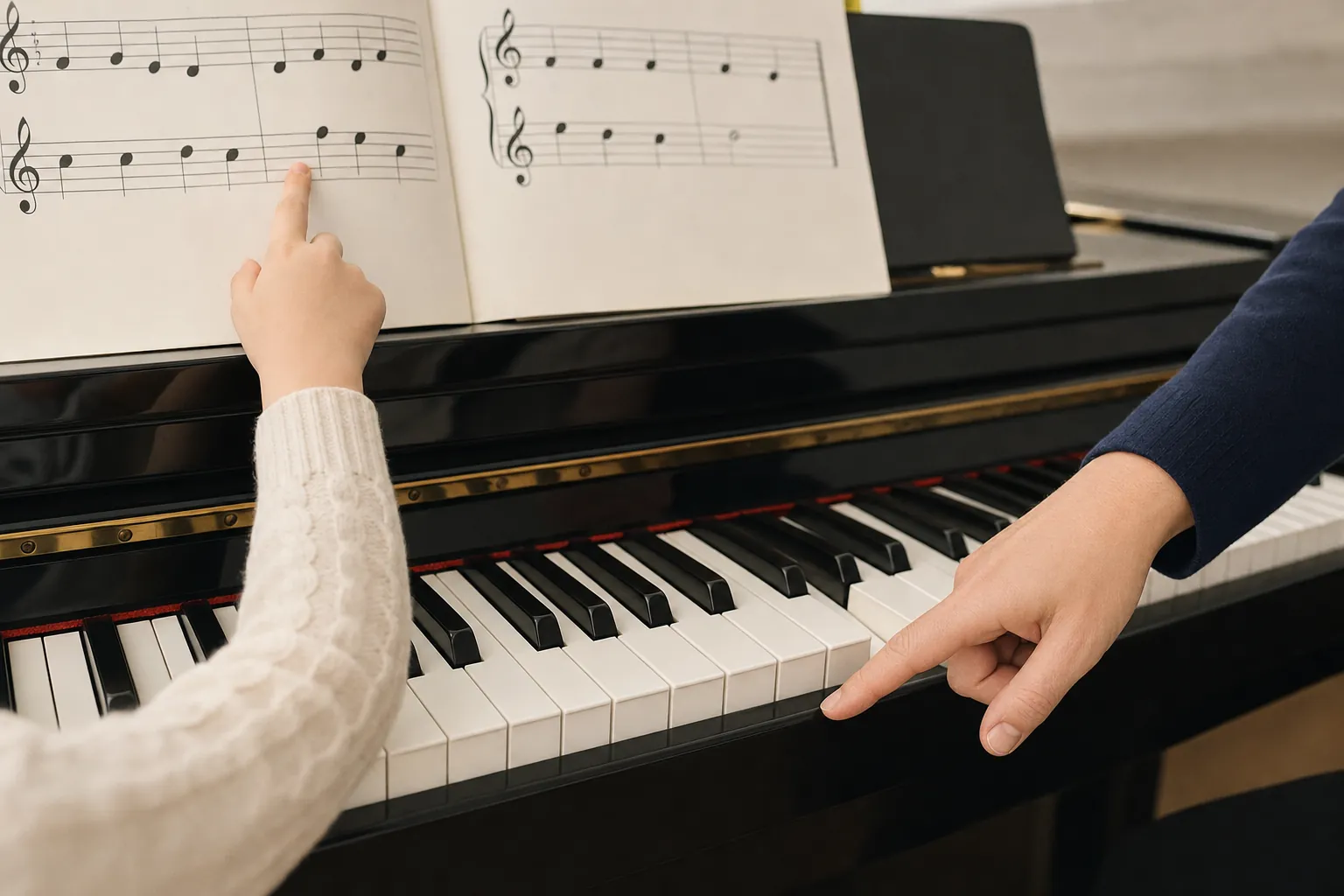
- Middle C. On a piano, it is near the center of the keyboard, close to the brand name or the meeting point between the two hands. On beginner music, it often appears on a short line between the two staffs.
- Treble G. The curl of the treble clef circles the line for G. That gives the right hand a dependable landmark.
- Bass F. The two dots of the bass clef sit around the line for F. That gives the left hand a matching reference point.
Once you find one landmark, look at the next note. Is it on the next line or space? It moves by a step. Does it skip over a line or space? It moves by a skip. Does it repeat in the same place? It repeats. This is often faster than stopping to name every note, especially in a beginner piece with simple melodic shapes.
At the keyboard, use the black-key pattern to stay oriented. Two black keys and three black keys repeat all the way across. The white key immediately to the left of each group of two black keys is C. Find that C, then find the note the page asks for by stepping up or down. Amabile's first piano lesson guide explains how teachers often use these patterns to make the keyboard feel familiar from the beginning.
Read Rhythm Before You Add Lots of Notes
A correct note played at the wrong time is still not the music you meant to play.
Rhythm tells you how long to hold a note and when the next sound begins. Before playing a new line, find the time signature near the beginning. In simple beginner music, 4/4 is common: there are four main beats in each measure. The vertical bar lines divide the page into those small, countable groups.
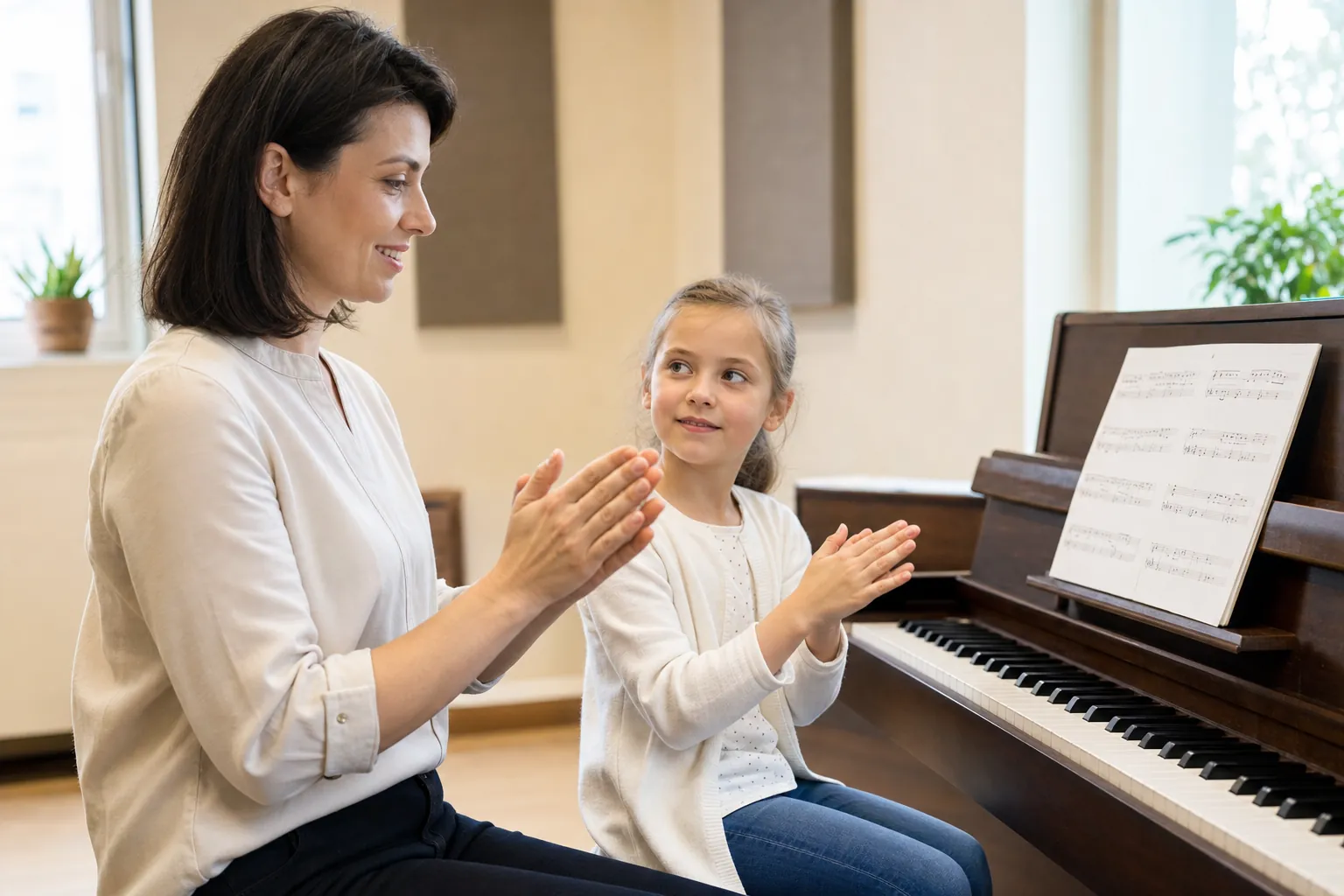
Start with the broadest note values: a whole note lasts four beats in 4/4, a half note lasts two, and a quarter note lasts one. You do not need to race through this. Tap your hand, count aloud, or walk the beat before you touch the keys. Yamaha's overview of staffs, measures, and time signatures offers a helpful second explanation of how those pieces fit together.
When eighth notes appear, think of them as two even sounds inside one beat. Count “one and two and” at a calm pace. If the rhythm feels confusing, remove the pitch completely: clap it, say it, or tap it on your knees. When the beat feels steady, add one or two notes back in. That order keeps your attention from getting overloaded.
Use the Note Shapes to See the Beat
The shape of a note gives you timing information before you even play it.
A note head is the round part of a note. An open note head usually lasts longer than a filled-in one. A stem adds more detail, and a flag or beam usually divides the beat into smaller pieces. Rests work the same way in reverse: they tell you when not to play, which is just as important as knowing when to begin.
Try this short process with any new measure:
- Point to the bar lines. Notice where the measure starts and stops.
- Count the beats without playing. Use a slow, even pulse that you can keep comfortably.
- Circle the longest note in your mind. It gives the measure a place to settle.
- Find any repeated rhythm. Repeated patterns are your friend; you do not have to solve the same problem twice.
- Play only one hand or one line. Add the second hand after the first rhythm feels reliable.
That is enough to get started. A page can contain many symbols, but beginners progress fastest when they sort the symbols into a few practical questions: Where is the beat? Which direction are the notes moving? Which pattern repeats?
Read Shapes, Not Just Letter Names
Good readers notice relationships between notes before they try to label every note.
Imagine three notes that climb one line or space at a time. You can see a staircase. Imagine notes that land on every other line or space. You can see a skip pattern. Those shapes tell your hands what is coming before your brain has time to say every letter name.
This is especially helpful on piano because the keyboard has its own visible geography. A step on the page usually means a neighboring white key or a nearby black key. A skip usually creates a slightly wider hand shape. Chords often stack notes vertically, so you can prepare more than one finger before you play. If you know one starting note, the relationships do much of the work.
That does not mean note names are unimportant. They matter when you are talking with a teacher, finding a starting point, or learning a new key. But naming should support playing, not interrupt it. The practical goal is to look at a short group of notes, hear its direction in your head, and let your hands follow that small map.
Put the Hands Together in Small Layers
Two staffs do not mean you must solve two hard problems at once.
Beginning piano music can feel intimidating because both hands may have notes on the page. The easiest response is to split the job into layers. Read the right hand by itself first, then read the left hand by itself, then choose one short measure where both hands can meet. That gives your eyes a fair chance to find each starting point instead of jumping back and forth across the page.
Before playing both hands, answer three small questions: Which hand begins first? Do the hands move at the same time or take turns? Which hand has the simpler pattern? In many beginner pieces, one hand holds a steady rhythm while the other hand moves. If you can hear that relationship before you play, the page becomes easier to organize.
Try a “silent setup” once before the sound begins. Place the fingers for the first notes of each hand, check that your shoulders are relaxed, and count one measure aloud. Then play only the first beat. Stop, reset, and repeat until that first beat feels ordinary. Add the next beat only after the first one is comfortable. It may feel slow, but it saves time because you are practicing the exact coordination that needs attention instead of rehearsing confusion.
When the hands finally come together, keep the tempo slow enough that you can continue after a small mistake. A steady, gentle pulse teaches your eyes to look ahead. Restarting every time something goes wrong teaches the opposite. This is how reading starts to feel like listening, not decoding. If a particular measure is still rough, bring it to the next lesson and ask the teacher to help identify whether the issue is rhythm, reading, fingering, or hand balance.
A 10-Minute Sheet Music Practice Routine
Short, repeatable work makes reading feel more automatic without turning practice into a marathon.
| Minutes | What to do | What it builds |
|---|---|---|
| 2 | Find middle C and one other landmark on the page and keyboard. | Orientation |
| 2 | Clap or tap one short rhythm while counting aloud. | Steady beat |
| 3 | Play one measure slowly with one hand, watching for steps, skips, and repeats. | Pattern reading |
| 2 | Play it again with a smooth, even count. | Connection between page and sound |
| 1 | Say what felt easier and mark the next small spot to review. | Helpful feedback for the next session |
Choose a line that is genuinely easy enough to read slowly. Sight-reading is not a test of whether you can survive the hardest page in the book. It is practice at noticing something new, keeping the pulse moving, and recovering calmly when a note goes wrong. The free keyboard and note-identification exercises at musictheory.net can also give you small, focused drills between lessons.
What to Do When You Get Stuck
The fastest way forward is usually to make the task smaller.
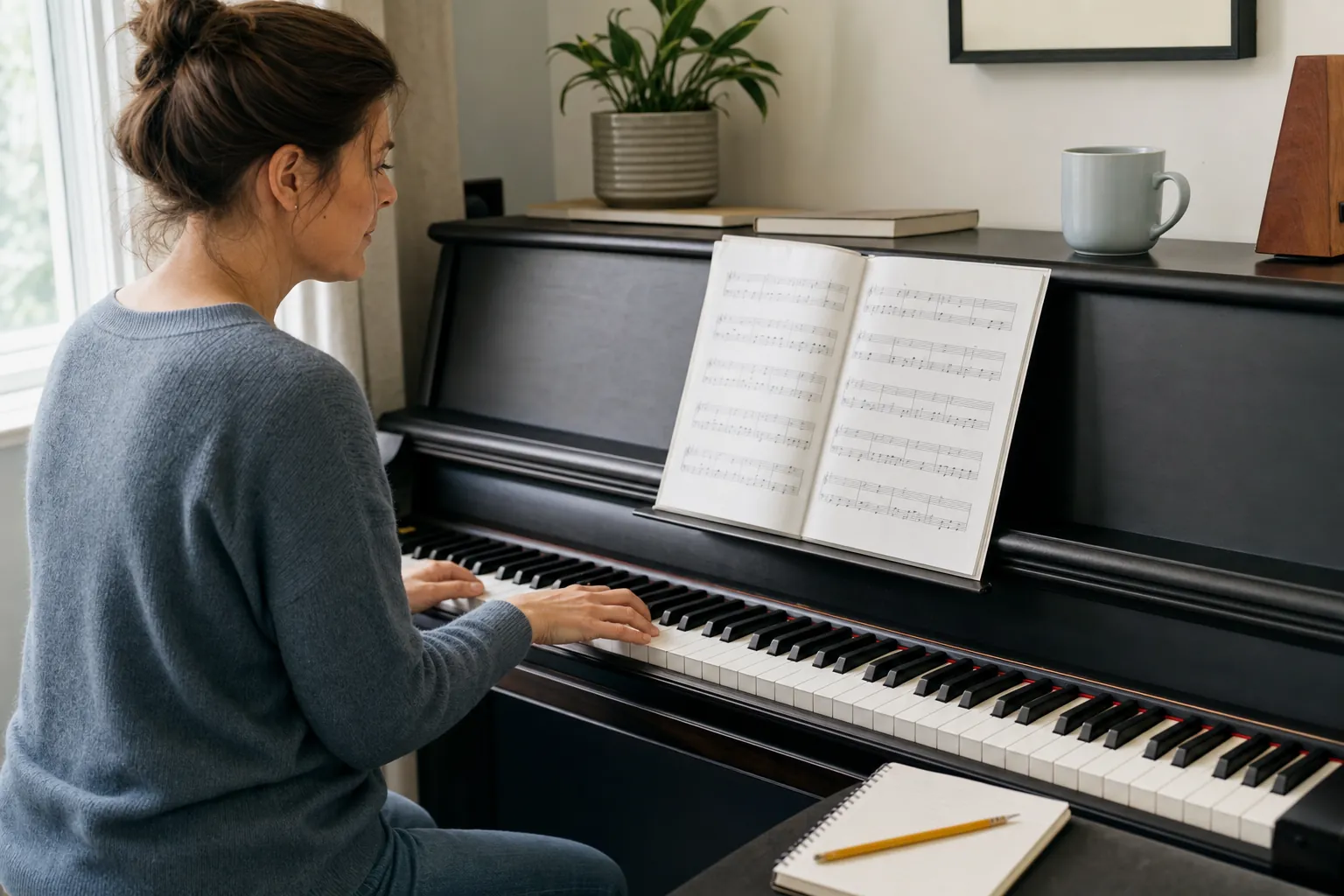
When reading falls apart, resist the urge to start the whole piece over and try harder. Stop at the smallest trouble spot. Is the problem the starting note, the rhythm, the hand position, or the way the notes move? Solve only that question first.
For example, if your right hand knows the notes but keeps arriving early, close the piano lid or move away from the keys and clap the rhythm. If the rhythm is fine but the notes are uncertain, play the line with a slow beat and name only the first landmark note. If two hands feel impossible together, keep one hand resting while the other plays. These are not shortcuts; they are the normal steps of learning a coordination skill.
Parents can help young beginners by asking, “Which measure should we look at?” rather than “Why did you miss that?” Adult beginners can use the same gentle reset. A calm, specific question keeps practice moving and makes it easier to tell a teacher exactly where support is needed at the next lesson.
How Amabile Helps Beginners Learn to Read Music
Reading is more comfortable when someone can connect the page, the instrument, and the student's pace in the same lesson.
At Amabile School of Music, beginning piano lessons give students a guided way to build those connections. A teacher can choose music that fits the student's current level, point out useful landmarks, and help rhythm become something the student can feel as well as count. That makes a difference for children who need a playful, patient start and adults who want a clear plan without being rushed.
Families can explore piano lessons for kids, while adult learners can see what to expect from adult piano lessons. The school also offers online music lessons for students who need a flexible format. For a better sense of a strong first step, review the beginner piano lesson guide, realistic piano practice guide, and lesson options and tuition.
Frequently Asked Questions
Can adults learn to read sheet music?
Yes. Adults can learn to read sheet music at any age. Adults often understand the explanation behind a pattern quickly, while the physical connection between page, eyes, and hands improves through short, repeated practice.
How long does it take to read sheet music comfortably?
The first landmarks and simple rhythms can become familiar in a few weeks of regular practice. Reading more smoothly takes longer because the skill grows through many small examples. A teacher can help make that progress feel organized instead of random.
Do I need to memorize every note name first?
No. Learn a few reliable landmark notes, then notice whether nearby notes move by steps, skips, or repeats. You will still learn note names, but you do not need to stop and spell every note before you can play a beginner piece.
Is it better to learn sheet music or play by ear?
Both skills are useful. Reading gives you a way to explore written music and share a piece accurately, while playing by ear develops listening and musical flexibility. Good lessons can build both instead of treating them as opposites.
What should a child practice first when learning to read music?
Start with a short piece that uses a few familiar notes and a steady beat. Help the child find one landmark, clap the rhythm, and play a single measure slowly. Small successes make reading feel approachable and give the teacher useful feedback at the next lesson.
Related Posts
More practical help for beginners and families building a confident piano routine.

What to Expect at Your First Piano Lesson
A calm introduction to the first meeting, the teacher, and the first week.
How to Practice Piano
A realistic routine for turning a lesson assignment into steady progress.
Piano Lessons for Beginners
What the first months can look like and how to choose the right support.