Quick answer
Group piano lessons for kids work best for young beginners who are still building attention, rhythm, listening, and confidence around the keyboard. They are especially useful around ages four to six when children benefit from movement, singing, games, and learning alongside peers. Private lessons are usually better once a child is ready for more individual correction, a longer attention span, and steady home practice.
What Group Piano Lessons Actually Are
A good group class is not four private lessons happening badly at the same time.
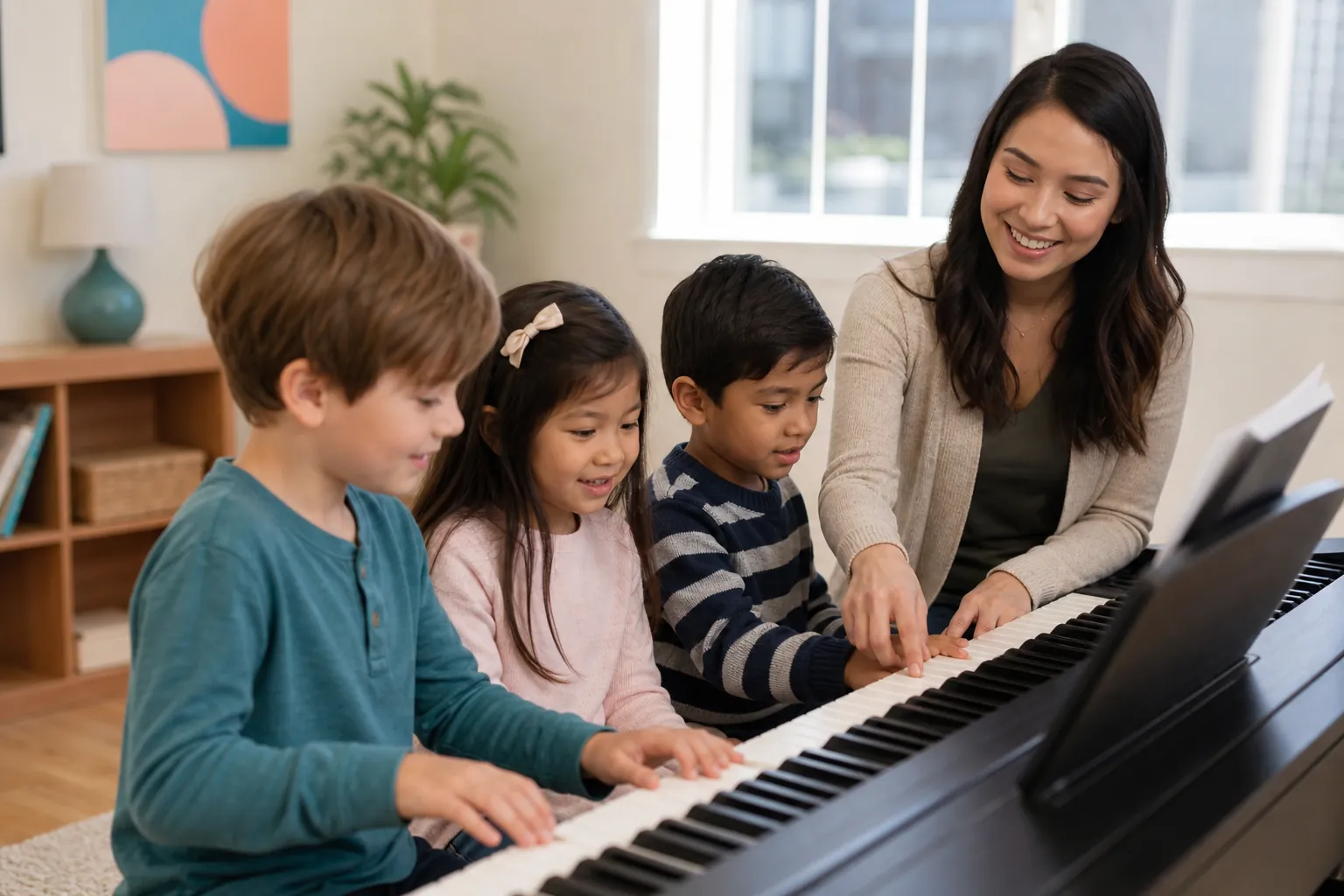
Parents often picture group piano lessons as several children lined up at keyboards while one teacher tries to keep everyone moving at the same speed. That version can exist, unfortunately, but it is not the model families should look for. A strong group class uses the social setting on purpose. Children clap rhythms together, sing patterns, take turns at the keyboard, listen to classmates, move to a steady beat, and learn classroom habits that make later private lessons easier.
For very young beginners, those habits matter. A four- or five-year-old may not be ready to sit alone at the piano for a traditional private lesson, but they can often learn musical patterns through short, varied activities. The Music Teachers National Association parent guide notes that early programs introducing piano are often designed for pre-first-grade children and include varied activities rather than only sitting at an instrument for 30 minutes.
That is the practical reason group piano lessons can be useful. They lower the pressure, let children watch peers try the same skill, and give the teacher more ways to build rhythm, pitch, finger awareness, listening, and participation. The goal is not to rush a child into impressive repertoire. The goal is to make the first contact with piano feel organized, joyful, and repeatable.
When Group Piano Is the Better First Step
Group lessons are strongest when the child needs readiness before individual instruction.
Group piano lessons are often a good fit when a child is curious about music but not quite ready for the focus and independence of private lessons. That includes children who love singing, dancing, tapping rhythms, or exploring sounds, but who still need help following directions, waiting for turns, and staying with one task for more than a few minutes.
In a good class, the teacher can rotate between activities before attention collapses. Children might echo rhythm patterns, identify high and low sounds, find black-key groups, sing solfege or simple melodies, try finger numbers, and play short keyboard patterns. Nobody needs a tiny Beethoven cosplay situation. They need the building blocks.
Group lessons can also help children who are nervous one-on-one. Some kids relax when they see other students trying, missing, laughing, and trying again. Peer energy can make participation easier. For a child who is very shy with adults, the group setting can be a soft landing before more direct individual feedback.
| Group piano may fit when | Private piano may fit when |
|---|---|
| The child is around four to six and still building classroom attention. | The child can focus one-on-one for a full lesson. |
| The family wants a playful introduction before formal study. | The student is ready for individual pieces, correction, and assignments. |
| The child learns well through movement, songs, repetition, and peers. | The student has specific goals or needs a tailored pace. |
| Parents want a lower-pressure way to test interest. | The student already practices steadily at home. |
What Kids Should Learn in a Beginner Group Class
The class should build readiness, not pretend every child is ready for the same method book.
Strong beginner group piano lessons usually cover more than keyboard notes. Children should build a sense of steady beat, rhythm, high and low sounds, loud and soft, finger awareness, listening, turn-taking, and simple keyboard geography. Those pieces might look simple from the outside, but they are what make later note reading and practice less frustrating.
The National Association for Music Education supports young children having access to structured and unstructured play-based music experiences, including group music-making, music listening, and joyful modeling from adults. That aligns with what good early piano programs do: they let children experience music through their bodies, ears, voices, and hands before asking them to behave like miniature conservatory applicants.
Parents should look for a class that has clear musical aims but still feels age-appropriate. If every activity is only entertainment, the class may be fun without building much skill. If every activity is formal keyboard work, the class may overload young children. The sweet spot is structure with variety.
A useful group class should include
Keyboard basics
Finding groups of black keys, finger numbers, simple patterns, and comfortable hand shapes.
Rhythm and beat
Clapping, tapping, stepping, echoing, and feeling steady pulse before notation gets heavy.
Listening and singing
Recognizing high and low, matching pitch, hearing patterns, and connecting voice to instrument.
Learning behavior
Taking turns, following short instructions, trying again, and participating without pressure.
How to Tell if the Class Is Well Run
The teacher should be warm, but warmth alone is not a curriculum.
A strong group piano teacher keeps the room moving without making the class feel frantic. Children should know what is happening, activities should transition smoothly, and the teacher should have more than one way to explain a concept. Young kids do not all learn on command because an adult said "focus." Shocking development, apparently.
Watch whether the teacher balances the group and the individual child. In a good class, each student gets moments of attention, but no one child is allowed to derail the whole lesson. The teacher should notice when a child is lost, offer a smaller step, and bring them back into the group without making them feel embarrassed.
Parent communication matters too. After class, you should understand what the children worked on and what, if anything, to repeat at home. A class that is only fun in the room but gives parents no bridge to practice will have less long-term value. Amabile's student resources and FAQ pages give families a sense of the support structure around lessons.
Group Piano vs Private Piano Lessons
The better option depends on readiness, not parental optimism.
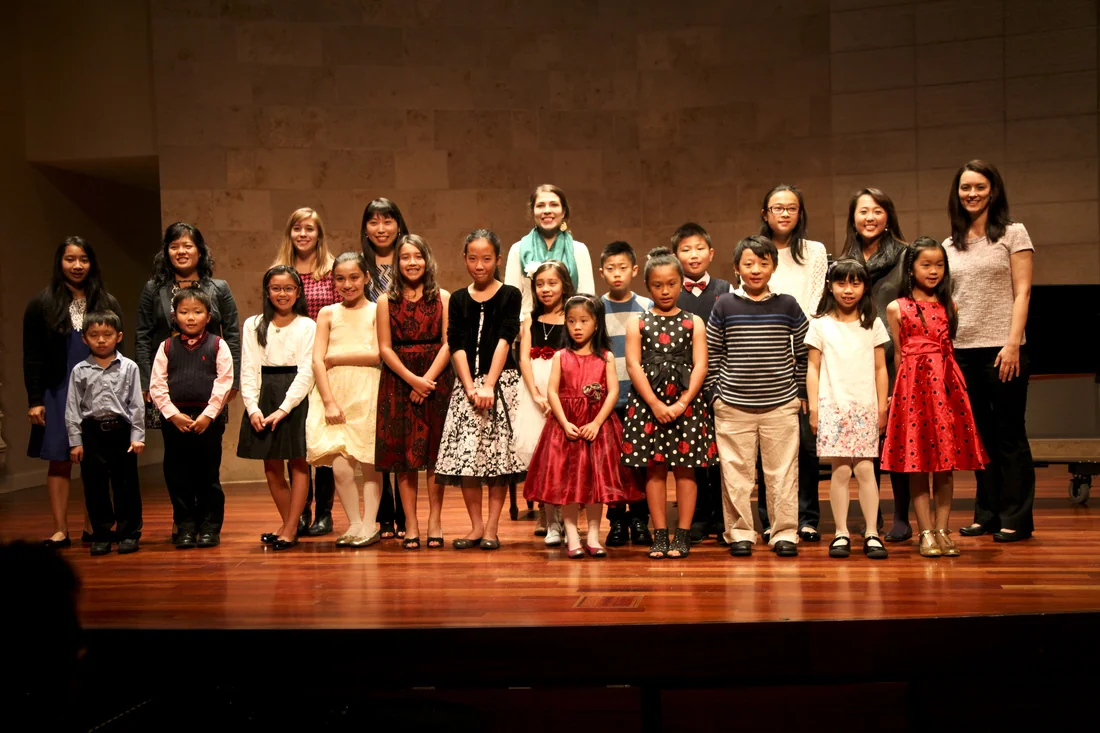
Group and private lessons do different jobs. Group piano lessons are usually best for early exposure, confidence, rhythm, social learning, and readiness. Private piano lessons are better for individualized technique, repertoire, reading, assignment pacing, and detailed correction. A child may need both at different stages.
If your child is five or older, interested in piano, and able to focus one-on-one, private lessons may be the right next step. Amabile's piano lessons and kids piano lessons pages explain how private instruction is structured for beginners. If your child is four or still needs a more playful bridge, the Little Mozart group class is the more natural place to start.
The best schools do not force every child into one lane. They help families decide whether the student needs readiness, individual instruction, or a transition plan. That decision is more useful than asking whether group or private is universally "better." Universal answers are neat. Children are not.
| Question | If yes, consider | Why it matters |
|---|---|---|
| Is the child under five? | Group class or readiness evaluation | Play, movement, and shorter activities usually fit better. |
| Can the child follow a teacher one-on-one? | Private beginner piano lessons | Individual correction becomes more useful. |
| Does the child love learning with peers? | Group piano or a hybrid path | Peer energy can build confidence and participation. |
| Does the student have specific goals? | Private lessons | The teacher can tailor repertoire, technique, and pace. |
What Parents Should Ask Before Enrolling
Good questions reveal whether the class has a real path beyond "cute kids at keyboards."
Before signing up, ask what ages the class is designed for, how many children are in the group, whether parents observe or participate, how keyboard time is handled, what happens at home between classes, and how the school decides when a child is ready for private lessons.
Also ask how the class handles different ability levels. Young children vary a lot. One child may already know finger numbers while another is still figuring out right and left. A good teacher can adapt without turning the class into chaos or leaving advanced beginners bored.
If the school offers both group and private options, ask for a recommendation based on your child's age, temperament, and goals. Amabile's pricing page helps families compare lesson formats and tuition, while the locations page helps families decide whether San Francisco, Moraga, or online lessons fit best.
How Amabile Helps Families Choose the Right Start
The right first format should make music feel possible, not premature.
Amabile works with young beginners, school-age children, teens, and adults across San Francisco, Moraga, and online. For very young children, the Little Mozart group class gives students a playful start with rhythm, singing, movement, keyboard basics, and early music habits. For children ready for individual instruction, private piano lessons give more direct teacher attention and a clearer weekly practice plan.
Families can compare Little Mozart, piano lessons, faculty, and program options before booking. A trial lesson or teacher conversation is useful because it turns a general question into a specific recommendation for your child.
If your child is eager but still young, start by asking whether the goal is readiness or individual progress. That one distinction saves families a lot of frustration. It also helps the first music experience feel encouraging enough that the child wants to come back.
Not sure whether group or private piano fits?
Tell Amabile your child's age, experience, attention span, and schedule. The next step is choosing the format that will make the first months feel successful.
Frequently Asked Questions
Short answers for parents comparing group and private piano lessons.
Are group piano lessons good for kids?
Yes, group piano lessons can be very good for young beginners when the class is age-appropriate, structured, and playful. They help children build rhythm, listening, turn-taking, keyboard awareness, and confidence before or alongside private lessons.
What age should kids start group piano lessons?
Many children can start a playful group piano or early music class around age four, depending on attention span, interest, and ability to follow simple directions. Private piano lessons often fit better around age five and older after a teacher evaluates readiness.
Are group piano lessons better than private lessons?
Neither format is automatically better. Group lessons are useful for readiness, confidence, rhythm, and social learning. Private lessons are better for individual correction, repertoire, technique, and a tailored practice plan.
Do kids need a piano at home for group lessons?
A home keyboard or piano helps, especially if the class gives short activities to repeat between sessions. Very young beginners may start with simple at-home rhythm and keyboard games, then move toward more regular practice as private lessons begin.
How do I know when my child is ready for private piano lessons?
Look for interest, ability to follow one-on-one instruction, basic attention for a lesson, willingness to repeat small tasks, and some parent support for practice. A trial lesson is usually the clearest way to judge readiness.